
26. Jun 2026
KOSIS DUVA Community Conference in Mannheim: Why is user feedback the key to successful modernisation?

Modern management software isn’t developed at a desk
Together with our client, we are working on modernising the Analysis Assistant (ASW) for the KOSIS consortium DUVA. The application helps local authority statistics departments to analyse and process data, and to make it usable for a wide variety of purposes.
What may appear at first glance to be a technical modernisation is, in practice, of great significance. Local authorities and statistical bodies need reliable tools to enable them to make well-informed decisions based on data. At the same time, expectations regarding user-friendliness, stability, accessibility and efficiency are rising.
This is precisely why we are adhering to a clear principle in this project: decisions should not be based on assumptions, but on validated insights from practical experience.
A community as a catalyst
DUVA is part of the KOSIS community – a network of around 200 institutional members comprising local authorities, research organisations and statistical bodies. Many of these organisations use the software on a daily basis or are directly involved in its further development.
The community conference therefore offers a unique opportunity: it brings together those who will later be working with the results of our work.
For us, the event was therefore the ideal venue to showcase the current state of development, gather feedback and tailor further development specifically to the needs of users.
User testing under real-world conditions
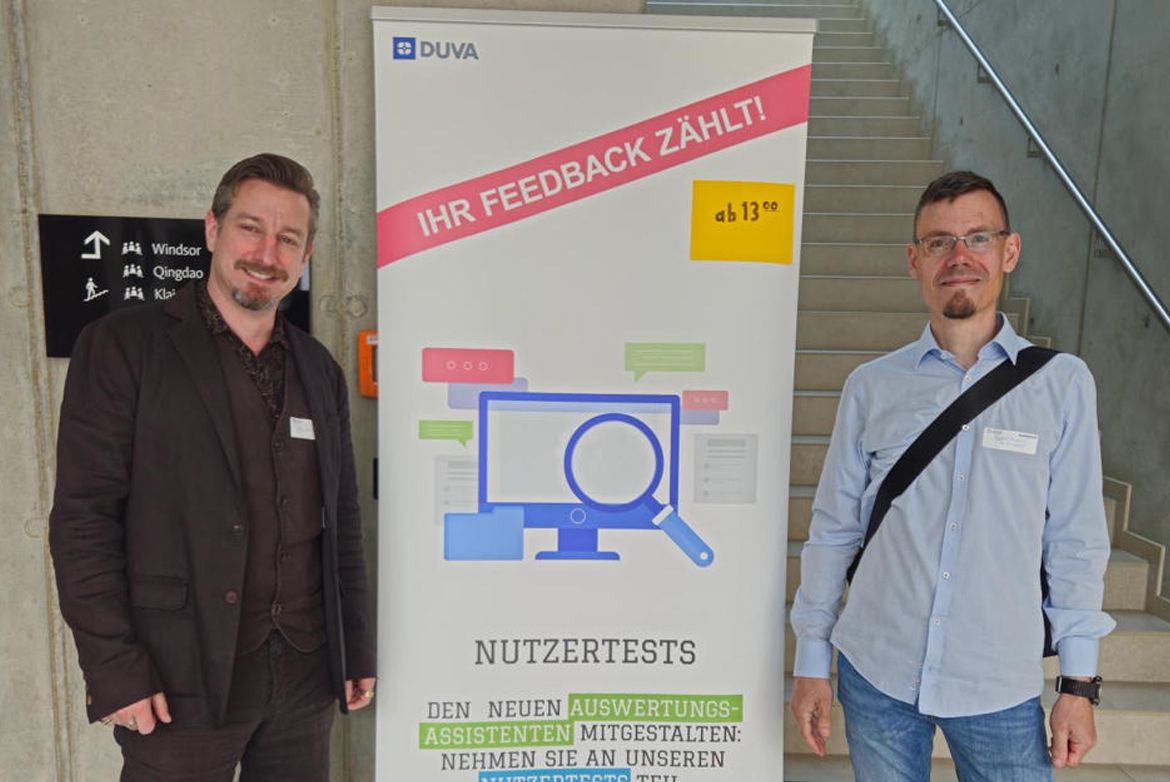
We were pleasantly surprised by the turnout at our stand. Over the course of the day, we were able to guide around 30 to 40 participants through demonstrations, tests and feedback sessions.
The structured user tests proved particularly valuable. Around 20 fully completed questionnaires, as well as numerous discussions and observations, provided us with concrete insights for the next stages of development. The most important finding: we are heading in the right direction.
The feedback confirmed that the key assumptions regarding the user interface and navigation are very close to the actual requirements of the target group. At the same time, we received numerous suggestions for fine-tuning – precisely those details that turn a good application into a very good one.
Transparency builds trust
In addition to the user tests, we also presented our approach and the current status of the project at the conference in a specialist presentation featuring a live demo.
Transparency is a key factor for success, particularly in modernisation projects within the public sector. Users want to be able to understand how decisions are made and what impact their feedback has on the development process.
That is why we deliberately adopt an iterative approach: identifying requirements, developing solutions, gathering feedback, implementing improvements – and repeating the process continuously.
The live demo provided an opportunity not only to explain this approach, but also to bring it to life for the audience.
Why is early validation so important?
Right from the start of the project, it became clear that a purely technical modernisation would not be enough. Together with our client, we therefore invested early on in requirements analysis, UX workshops, user interviews, quality requirements, IT security and accessibility. The visit to Mannheim demonstrated just how valuable this approach is.
Rather than questioning fundamental assumptions only shortly before the roll-out, we were able to validate them with real users. This reduces project risks, builds acceptance and ensures that development resources are invested where they deliver the greatest benefit.
A strong signal of cooperation
As well as the technical insights, there was another outcome that pleased us particularly: the positive feedback from our client.
The KOSIS-Gemeinschafts-DUVA conference is not a traditional client meeting, but rather a gathering of a specialist community. This makes it all the more meaningful when the collaboration and the quality of the results are explicitly highlighted in a positive light.
For us, this confirms that successful digitalisation does not arise from technology alone. It arises from partnership, transparency and continuous dialogue with the people who will ultimately use the software.
Conclusion
The two days in Mannheim have shown just how important it is to involve users directly in order to ensure the success of software projects.
The insights gained will be incorporated directly into the further development of the DUVA evaluation assistant. At the same time, the event has confirmed that our user-centred and quality-oriented approach is proving successful.
We look forward to taking the next steps together with our client and the KOSIS community.
Would you like to find out how Accso can support your company with digitalization, AI, and innovation?
Contact us for a no-obligation consultation!